8 min read
GEO vs SEO: How to Get Your Business Cited by ChatGPT and Google AI
GEO helps AI tools like ChatGPT, Gemini and Google AI Overviews cite your business. Learn how it differs from SEO and the steps that work in 2026.
GEO (generative engine optimization) means making your content easy for AI tools like ChatGPT, Gemini, Perplexity and Google's AI Overviews to find, trust and quote. SEO means ranking your pages in normal search results. In 2026 the two overlap a lot, and most of what helps one also helps the other.
More people now ask an AI a question instead of scrolling through ten blue links. If the AI names your competitor and not you, you lose that customer before they ever visit a website. This guide explains GEO vs SEO in plain English, what Google itself says about it, and the practical steps a small business can take this month.
What is generative engine optimization (GEO)?
A generative engine is any AI tool that writes an answer instead of just listing links. GEO is the work of shaping your website and online presence so these tools pick your business as a source.
The term comes from a 2023 research paper later presented at the KDD 2024 conference. Its authors found that changing how content is written could raise its visibility in AI answers by up to 40%. You may also see similar ideas called AEO (answer engine optimization), AIO or LLM optimization. They all describe the same goal.
GEO vs SEO: what is the difference?
The easiest way to see it: SEO fights for a position on a results page, while GEO fights for a mention inside one written answer. One answer often cites only a few sources, so being clear and trustworthy matters even more.
SEO
Goal: rank your page in search results.
Win: a click to your site.
Measured by: rankings, clicks and traffic in Google Search Console.
GEO
Goal: be cited or named in AI answers.
Win: your brand in the answer, often with a link.
Measured by: how often AI tools mention you for your key questions.
What both need
Pages that can be crawled and indexed, original and helpful content, clear structure, a trusted brand and up-to-date facts.
What Google says about GEO (and the myths it clears up)
In July 2026, Google published a guide to optimizing for its generative AI features. Its main message is simple: optimizing for AI search is still SEO. Google's AI Overviews and AI Mode are built on its normal ranking systems, and its AI features page says there are no extra requirements to appear in them.
The guide also clears up some popular GEO myths:
- Myth: you need special AI schema markup. Google says there is no special markup for its AI features. Structured data is still useful for rich results, so keep it.
- Myth: an llms.txt file will get you into Google's AI answers. Google says it does not use these files. Other AI tools may read them, so they do no harm, but they are not a Google ranking factor.
- Myth: you must chop content into tiny chunks. Google says its systems understand pages with several topics and there is no ideal length.
- Myth: GEO hacks work. Google warns against making pages for every small variation of a question, and against fake mentions.
How do AI search engines choose which sources to cite?
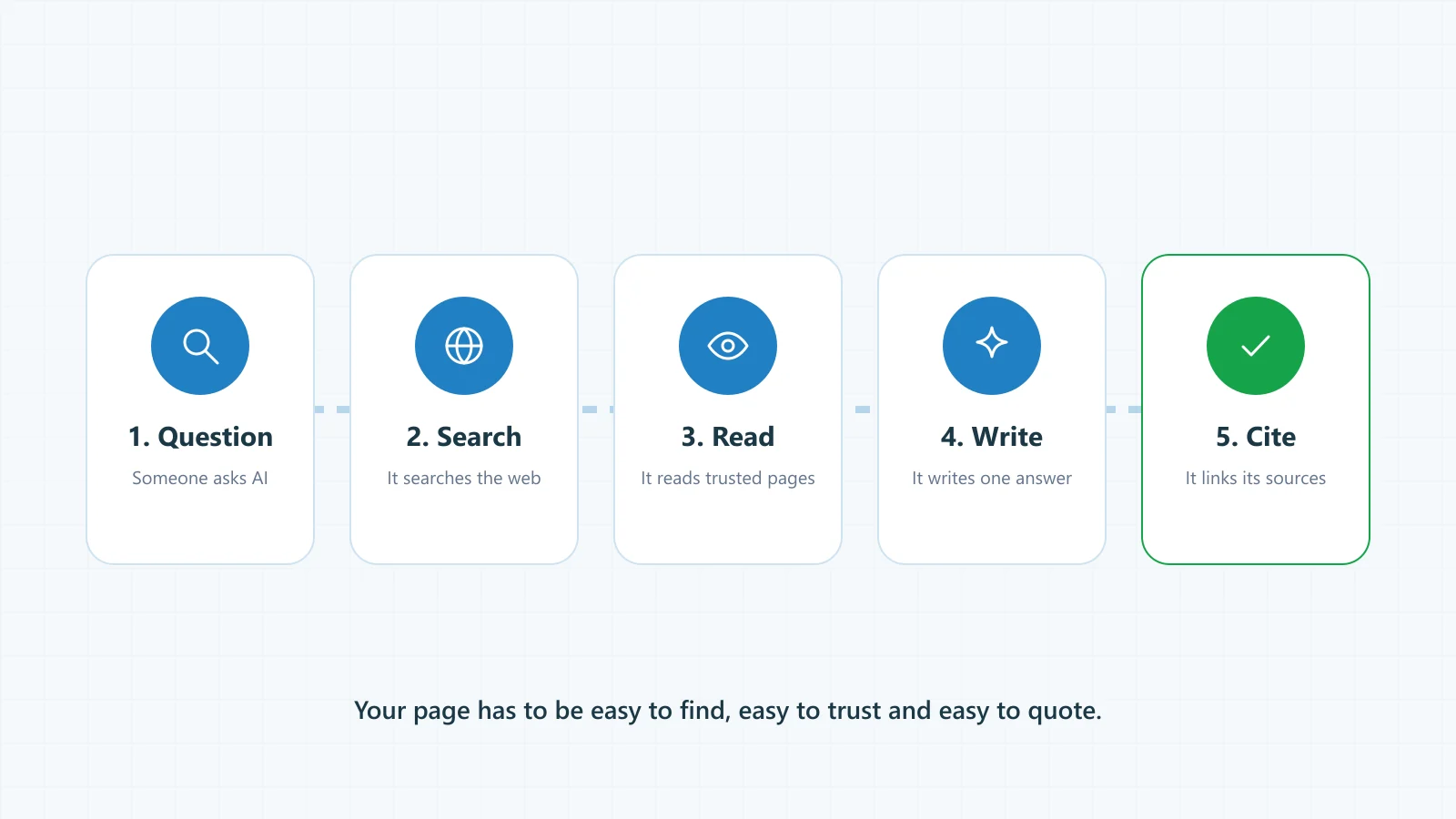
Most AI answer tools follow a similar loop. They take the question, search an index of web pages, read the most relevant results, write one combined answer and link to the pages they used. If your page is not in the index, it cannot be picked. If it is vague or hard to quote, a clearer page wins.
This is why classic SEO basics still matter for GEO. A page that is blocked from crawlers, loads slowly or hides its main answer will struggle in both normal search and AI search.
9 GEO steps a small business can take this month
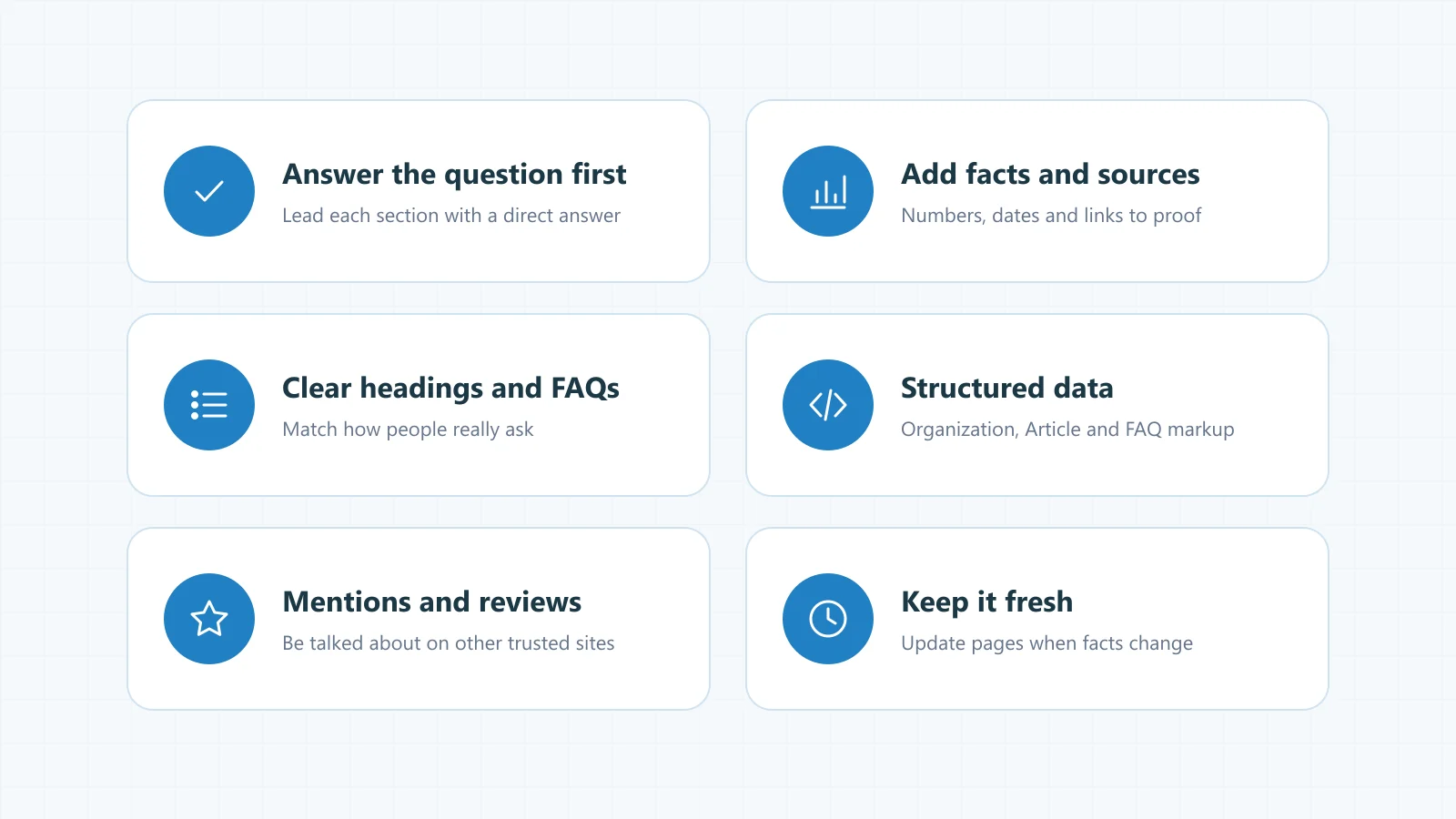
- Answer the question first. Start each page and section with a one or two sentence answer, then explain. AI tools quote clear answers more easily.
- Add facts, numbers and sources. Use specific prices, dates, steps and data, and link to the original source. Vague claims are hard to quote.
- Write headings as real questions. Use the words customers actually type or say, and add an FAQ section with short, direct answers.
- Make it obvious who you are. Keep your business name, address, services and contact details the same on your site, social profiles and directories. A clear About page helps AI tools understand your brand.
- Use structured data. Add Organization, Article and FAQ markup. It is not required for Google's AI features, but it helps search engines read your pages and qualify for rich results.
- Earn mentions on trusted sites. Reviews on your Google Business Profile, posts on LinkedIn, YouTube videos and features in local or industry sites all give AI tools more reasons to trust you.
- Keep pages crawlable. Do not block search engine crawlers you want to be found by. Submit your sitemap in Google Search Console and Bing Webmaster Tools, and use IndexNow so new pages are found fast.
- Publish something only you can say. Share your own results, examples, process and opinions. This is the unique content Google says matters most.
- Keep it fresh. Update pages when prices, laws or tools change, and show the date. Old facts get replaced by newer sources.
How to measure your AI search visibility
GEO is newer than SEO, so the tools are still catching up. A simple routine works well for most small businesses:
- Check Search Console. Google's guide points to a generative AI performance report in Search Console, and traffic from AI Overviews and AI Mode is counted in your search data.
- Ask the AI tools yourself. Once a month, ask ChatGPT, Gemini, Perplexity and Google AI Mode the 10 questions your customers ask most. Note whether you are named, linked or missing.
- Watch referral traffic. In your analytics, look for visits from sites like chatgpt.com, perplexity.ai and gemini.google.com.
- Track branded searches. If more people search your business name over time, your visibility in AI answers is often part of the reason.
GEO mistakes to avoid
- Creating dozens of near-identical pages for every way a question can be asked.
- Buying fake reviews or paying for spam mentions. AI tools and search engines both get better at spotting these.
- Stuffing keywords into every sentence until the page reads badly.
- Publishing thin AI-written articles that add nothing new.
- Blocking crawlers by accident in robots.txt or with a login wall.
Is SEO dead because of AI search?
No. AI search runs on top of search indexes, and Google says its AI features use the same core ranking systems. What has changed is the reward. A strong page may now win a mention in an AI answer instead of, or as well as, a click. Good SEO is the foundation that GEO is built on.
The bottom line
You do not need a secret GEO trick. You need pages that answer real questions clearly, show proof, and come from a brand that other trusted sites talk about. Do that well and you give both search engines and AI tools every reason to send people your way.
How AriseAbility can help
AriseAbility offers SEO, content writing and digital marketing services for businesses worldwide, from our base in Multan, Pakistan. We practise what this guide says on our own site, with FAQ structured data, an llms.txt file and IndexNow for fast indexing.
Curious how AI is changing the rest of your business too? Read our guide to AI agents for small business, or learn what AriseAbility does. We share short SEO and AI tips on LinkedIn, Instagram, TikTok and YouTube.
Frequently asked questions
What is GEO in simple words?
GEO, or generative engine optimization, is the work of making your business easy for AI tools like ChatGPT, Gemini and Google AI Overviews to find, trust and mention in their answers. It builds on SEO, with extra focus on clear answers, proof and a trusted brand.
What is the difference between GEO and SEO?
SEO aims to rank your page in search results so people click through. GEO aims to get your business cited or named inside an AI-written answer. Both rely on crawlable pages, helpful original content and trust, so the same work usually helps both.
Does GEO replace SEO?
No. Google says optimizing for its generative AI features is still SEO, because those features use its core ranking systems. Think of GEO as SEO adapted for answers instead of only rankings.
How do I get my business mentioned by ChatGPT?
There is no guaranteed way, but you can improve your chances. Make sure your site can be crawled, answer common customer questions clearly, keep your business details the same everywhere online, and earn reviews and mentions on trusted sites like Google Business Profile, LinkedIn and industry directories.
Do I need an llms.txt file for AI search?
Not for Google. Google says it does not use llms.txt files for Search. Some other AI tools may read them, so adding one is harmless, but it will not replace good content and SEO.
Does schema markup help with AI search?
Google says there is no special schema needed for its AI features. Structured data such as Organization, Article and FAQ markup still helps search engines understand your pages and can make them eligible for rich results, so it is worth keeping.
How long does GEO take to work?
It depends on how often search engines crawl your site and how strong your brand already is. New or updated pages can be picked up in days, but building the trust and mentions that lead to regular AI citations usually takes months of steady work.
How can I check if AI tools mention my business?
Ask ChatGPT, Gemini, Perplexity and Google AI Mode the questions your customers ask, and note whether your business appears. Repeat monthly, and check Google Search Console and your analytics for traffic from AI features and AI tools.
Can a small business do GEO without an agency?
Yes. Start with the basics in this guide: clear answers, real facts, an FAQ section, a complete Google Business Profile and regular reviews. An agency helps most when you need technical SEO fixes, structured data or a steady content plan.