7 min read
Vibe Coding vs Hiring a Developer: When Is an AI-Built Website Enough?
Vibe coding lets you build a website or app by chatting with AI. Learn when it is enough, where it goes wrong and when to bring in a developer in 2026.
Vibe coding means building a website or app by describing what you want to an AI tool and letting it write the code. It is great for landing pages, prototypes and simple internal tools. But once your site handles logins, payments or personal data, you should bring in a developer, at least to review it before launch.
The idea has spread fast. "Vibe coding" was named Collins Dictionary's Word of the Year for 2025, and founders everywhere now ask the same question: do I still need to hire a developer? This guide gives you an honest answer, with the risks, the real limits and a simple way to decide.
What is vibe coding?
The term was coined by AI researcher Andrej Karpathy in February 2025. He described a way of working where you "give in to the vibes": you ask the AI for what you want, accept its code, and keep going without reading every line.
Popular tools include Lovable, Bolt, Replit, v0, Cursor and Claude Code. Some are built for people with no coding experience. Others are coding assistants for developers. They all let you turn plain English into working software much faster than before.
What vibe coding is great at
- Testing an idea fast. Build a clickable version in a day and show it to real customers before you spend serious money.
- Simple landing pages. A one-page site for an event, a product launch or a waiting list.
- Internal tools. A small dashboard or calculator that only your team uses.
- Learning. Seeing how an app fits together is a great way to understand code, especially alongside a proper course.
- Talking to developers. A working prototype explains what you want far better than a long document.
Where vibe-coded websites and apps go wrong
The problem is not that AI writes bad code all the time. It is that it can write code that works on screen but is unsafe underneath, and a non-coder has no way to tell the difference.
Security gaps you cannot see
In a 2025 study by Veracode, AI models were given 80 coding tasks. They added a security weakness in 45% of cases, even though the code worked. Common misses included protection against cross-site scripting, a classic way attackers inject harmful code into a page.
Real incidents show the risk. A 2025 flaw logged as CVE-2025-48757 found that weak database access rules in apps built with Lovable let outsiders read or change data without logging in. In February 2026, The Register reported a researcher's claim that one Lovable-hosted app exposed data on about 18,000 users. In both cases, the missing piece was the kind of access check a developer review is meant to catch.
Maintenance and growth
Every website needs updates, backups and fixes. When nobody understands the code, a small change can break something else, and the AI may go in circles trying to fix it. As the app grows, these problems grow too.
Hidden costs and lock-in
Many vibe coding tools charge monthly plans with usage credits, so heavy editing costs more. Some host your app on their own platform. Before you build, check whether you can export your code and move it elsewhere.
Vibe coding vs hiring a developer: side by side
Vibe coding
Fast and low cost to start. Best for ideas, demos and simple pages. You carry the risk of security gaps and harder maintenance.
Hiring a developer
Slower and costs more upfront. Best for anything with users, payments or sensitive data. You get secure, maintainable code and someone accountable.
Hybrid
Prototype with AI, then have a developer review, fix and launch it. Often the best balance of speed, cost and safety.
Which one should you choose?
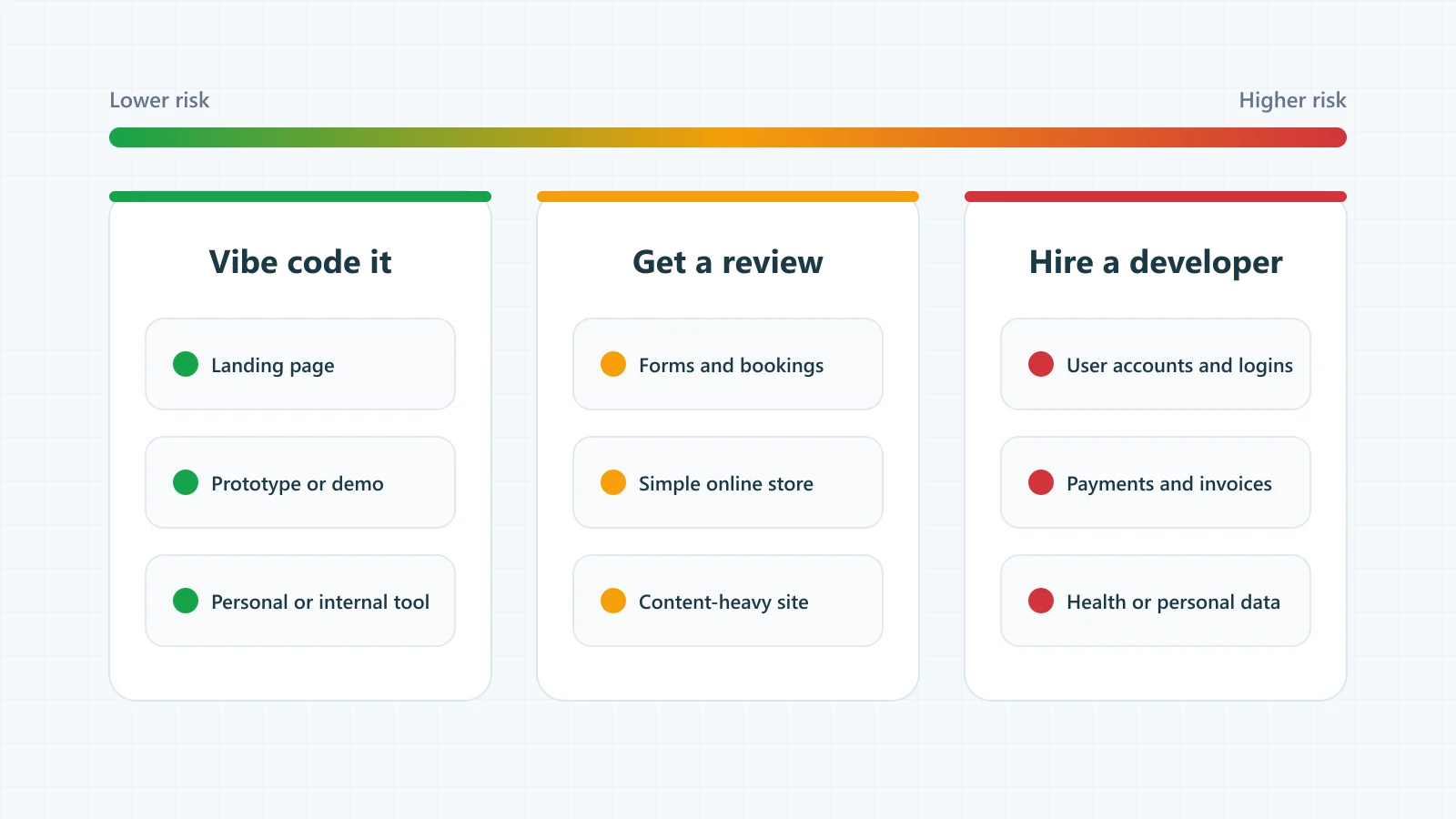
Ask yourself these five questions. If you answer yes to any of the last three, plan for a developer.
- Is this an experiment I might throw away in a month?
- Is it a simple page with no logins or stored data?
- Will people create accounts or log in?
- Will it take payments or store personal, health or business data?
- Will my business depend on it working every day?
The hybrid path: prototype with AI, launch with a developer
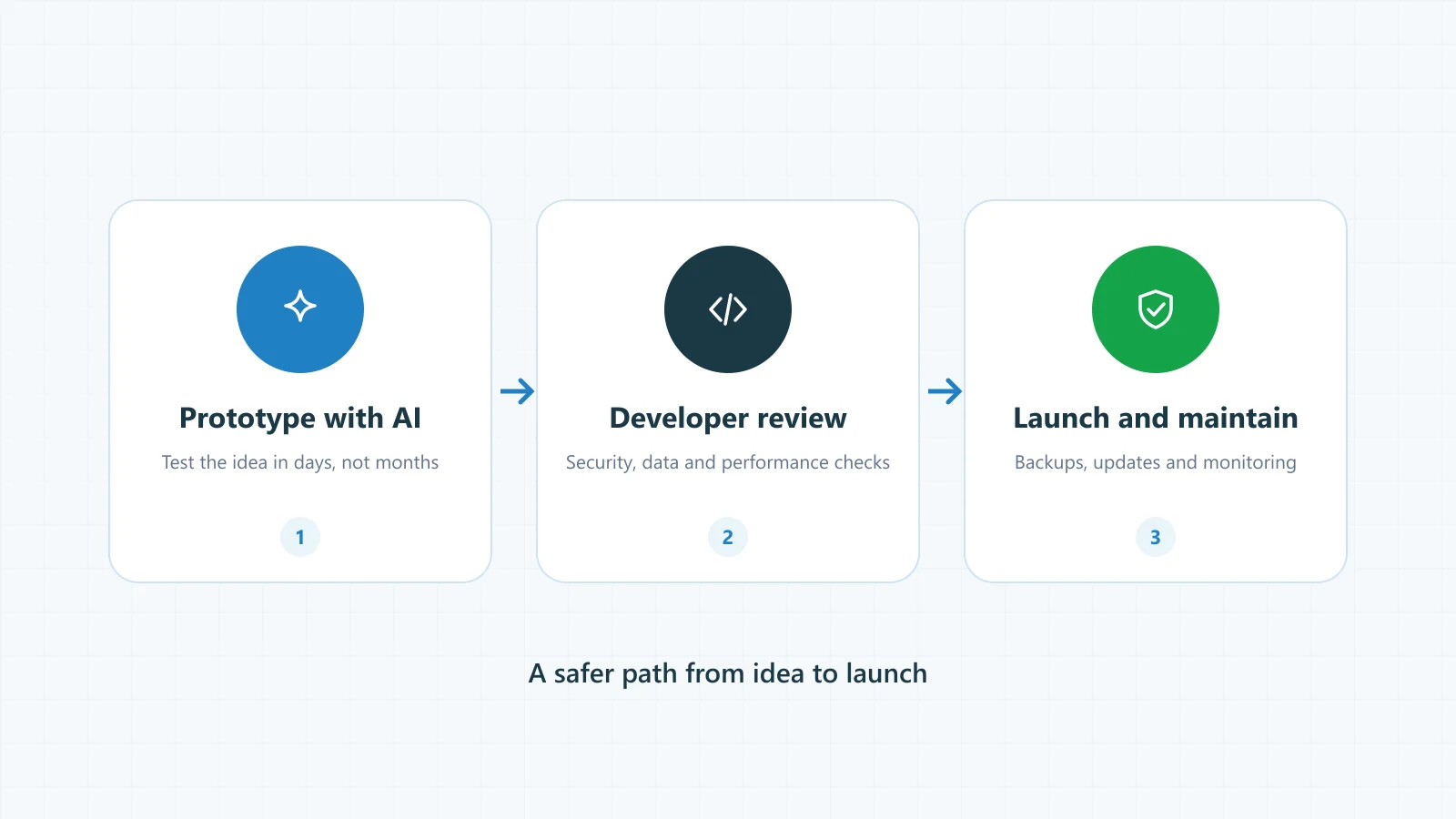
This approach keeps the best part of vibe coding, which is speed, and removes most of the risk. When a developer reviews an AI-built app, these are the main things they check:
- Logins and access rules. Can users only see and change their own data? This includes database rules like row-level security.
- Secret keys. API keys and passwords must never be visible in the browser.
- Input checks. Forms must reject harmful or broken input.
- Payments. Payments should go through a proven provider, never through custom card handling.
- Backups and monitoring. You need a way to restore data and to know when the site is down.
- Speed, SEO and accessibility. Fast pages, proper titles and descriptions, and a site that works with screen readers and keyboards.
Will AI replace web developers?
AI is changing what developers spend their time on, not removing the need for them. Developers now use the same AI tools to work faster, while focusing on security, design decisions and keeping systems running. For business owners, that often means a developer can deliver more in less time than before.
The bottom line
Vibe coding is a brilliant way to test ideas and build simple pages. It is a risky way to run anything that holds customer data or money. Use AI for speed, use a developer for safety, and decide based on what your site needs to protect.
How AriseAbility can help
AriseAbility builds websites, web apps and mobile apps for clients worldwide from Multan, Pakistan. We use AI tools in our own work every day, and we know how to turn a promising prototype into something secure and ready for real users. See what we have built in our portfolio.
Want to understand the code yourself? Start with our free Python and AI courses on YouTube. You might also like our guides to AI agents for small business and GEO vs SEO. For quick tips, follow us on LinkedIn, Instagram and TikTok.
Frequently asked questions
What is vibe coding?
Vibe coding is building software by describing what you want to an AI tool in plain language and accepting the code it writes, often without reading it closely. The term was coined by Andrej Karpathy in February 2025 and became Collins Dictionary's Word of the Year for 2025.
Is vibe coding safe for a business website?
It is usually fine for simple pages with no logins or stored data. For sites with user accounts, payments or personal information, it is risky without a review, because AI-written code often contains security gaps that look fine on screen.
Can I build an app with no coding experience?
Yes, tools like Lovable, Bolt and Replit let you build a working app by chatting with AI. Getting it secure, reliable and easy to maintain is harder, so plan for a developer's help before real users or payments are involved.
Is vibe coding cheaper than hiring a developer?
At the start, yes. Over time the gap can shrink, because fixing security problems, rebuilding messy code and paying for usage credits all add up. For anything your business depends on, compare the full cost over a year or two, not just the first month.
What are the most popular vibe coding tools?
Common choices in 2026 include Lovable, Bolt, Replit and v0 for building apps from a prompt, and Cursor and Claude Code for people who want to work closer to the code. The best one depends on your project and how much control you need.
Will AI replace web developers?
Not for serious projects. AI speeds up coding, but businesses still need people who understand security, data, design and long-term maintenance. Most developers now use AI tools to deliver faster.
Can a developer fix my vibe-coded app?
Usually, yes. A developer can review the code, fix security gaps, clean up the structure and set up hosting and backups. If the code is very tangled, rebuilding key parts can be cheaper than patching them.
Who owns the code from a vibe coding tool?
It depends on the tool's terms of service. Many let you export your code or sync it to GitHub. Check this before you build, so you can move your app or hire a developer later without starting over.